How Rustbox Helps Coding Assessment Platforms Run Submissions Faster
Learn how Rustbox helps coding assessment platforms run submissions faster with a focused code execution API, clear verdicts, SDKs, and webhooks.
Coding assessment platforms live or die on speed and trust. Candidates expect quick feedback, recruiters expect stable sessions, and engineering teams expect results they can reason about. Rustbox helps by giving assessment products a focused execution API for running submissions without building the whole code runner stack in-house.
Why submission speed matters in coding assessments
A coding test is not just a form. It is a timed, high-pressure product experience. Every slow submission breaks concentration. Every unclear result creates support tickets. Every failed runner can make a strong candidate look unreliable.
Fast code execution matters because feedback is part of the assessment loop. A candidate writes code, runs it, learns from the result, and adjusts. If that loop feels heavy, the platform feels heavy.
Rustbox is designed for products that need to run code on demand and return structured results. The goal is simple: make execution feel like a dependable product primitive instead of a fragile background job.
The Rustbox Execution Pipeline
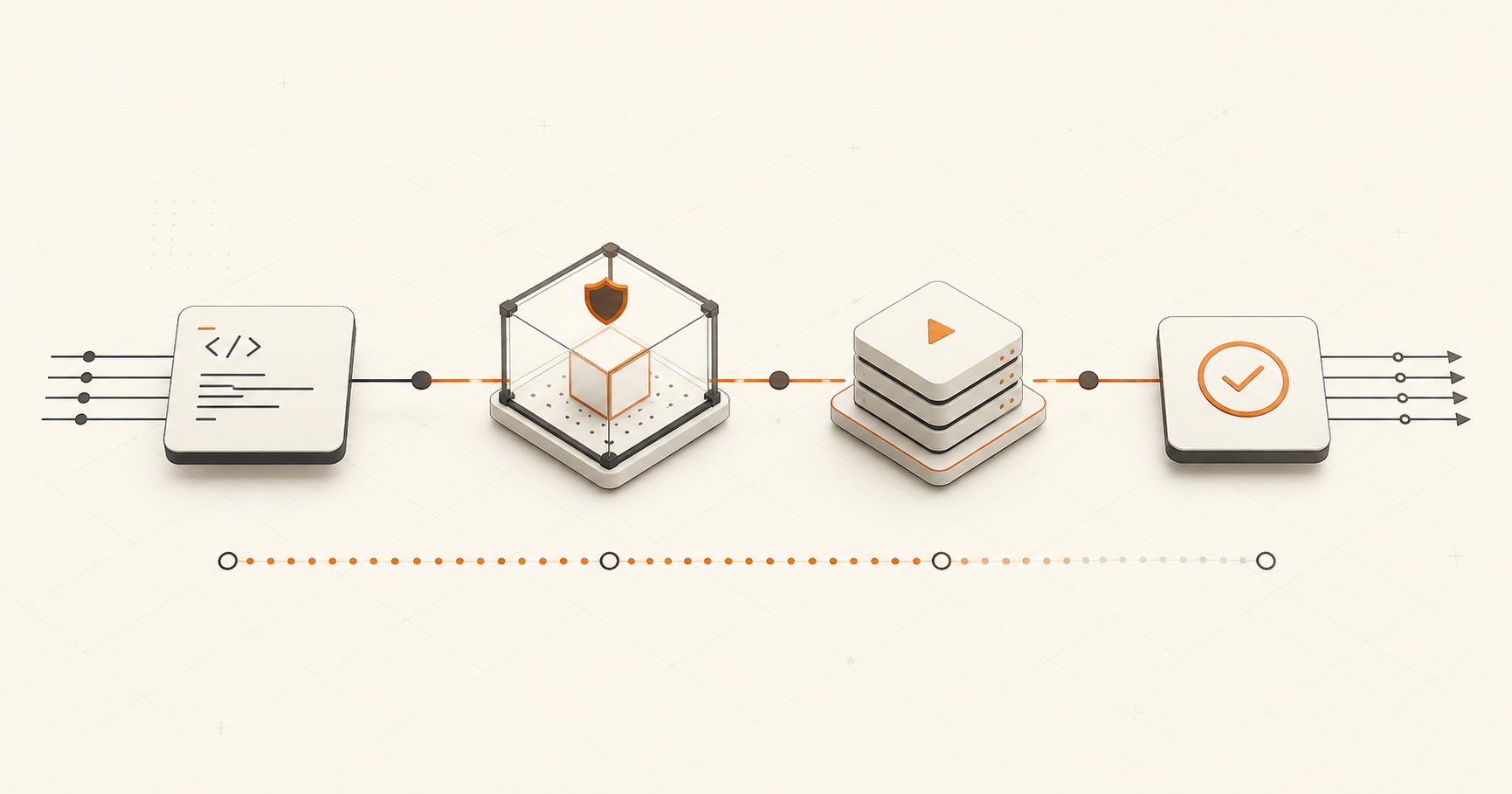
When a candidate clicks "Run Code," the submission travels through a multi-stage security and optimization pipeline. Rustbox completes this entire lifecycle in milliseconds rather than seconds:
API Gateway
Accepts code, validates headers, checks API tokens, and assigns a unique execution UUID.
Secure Enclave
Spins up a lightweight, kernel-isolated runtime using namespaces, cgroups, and seccomp.
Run & Monitor
Executes the submission with strict timeout bounds, collecting real-time memory and CPU utilization.
Classification
Standardizes outputs and returns a structured payload (e.g. `accepted`, `timeout`, `runtime_error`).
Where coding assessment runners usually slow down
Most internal code runners start small. A team adds a worker, a queue, a language image, and a timeout. That works until usage grows or the product adds more languages, more candidate traffic, more grading modes, and more reporting requirements.
The slowdown rarely comes from a single line of code. It comes from the whole path around the submission: preparing the run, enforcing limits, collecting output, classifying the result, saving the record, retrying transient failures, and notifying the product when execution is complete.
Assessment teams also need consistency. A result should mean the same thing whether the candidate submitted Python, C++, JavaScript, Go, or Rust. If every language path behaves differently, the grading layer becomes harder to trust.
Dynamic Latency Benchmarks by Language
By maintaining pre-pooled environment sandboxes, Rustbox minimizes runtime bootstrapping. Symmetrical compilation and interpretation overhead averages show how fast feedback is delivered to candidate browsers:
Direct script interpretation with instant sandbox provisioning.
Fast GCC compilation and secure sandboxed native run.
Optimized JVM boot time leveraging warmed class loading.
What faster submissions mean for your product
Faster submission handling is not only about latency. It changes how the assessment product feels. Candidates see a tighter feedback loop. Hiring teams see fewer stuck sessions. Support teams get clearer records when something fails.
| Problem | Impact | Rustbox role |
|---|---|---|
| Slow feedback | Candidates lose flow during timed tests. | Use sync execution for quick interactive runs. |
| Batch grading | Large test sets can overload simple request flows. | Use async submission and poll by execution ID. |
| Result delivery | Workers finish after the candidate view changes. | Use webhooks to push completed results. |
A practical Rustbox integration pattern for assessments
Start with the simplest path. For a run button in an assessment UI, use the Rustbox API with sync execution. The candidate submits code, the UI waits briefly, and the product renders stdout, stderr, and the verdict.
For final grading, use async execution. Store the returned execution ID with the candidate attempt, poll until completion, then write the score into your own assessment database. If your platform grades many submissions in the background, configure Rustbox webhooks so completed results flow back to your backend.
"By decoupling execution, your team owns the core product logic (assessment rubrics, user sessions, grading test suites), while Rustbox handles safe, high-speed code execution."
Frequently asked questions
Can Rustbox power coding interview platforms?
Yes. Rustbox is a good fit for platforms that need to run submitted code, return verdicts, and support multiple languages through a consistent API.
Should coding assessments use sync or async execution?
Use sync execution for interactive run buttons where the candidate is waiting. Use async execution for final grading, batch workloads, or flows where the result can arrive after the request ends.
Does Rustbox replace my grading logic?
No. Rustbox runs the code and returns structured execution results. Your product still decides how to compare outputs, assign scores, enforce rubrics, and present feedback.
Build faster coding assessments with Rustbox
Use the Rustbox quickstart to send a first submission, inspect the result, and choose the integration pattern that fits your product.
Open Rustbox quickstart